A Bolsa de Criação Local OUT.RA 2026, atribuída à artista visual e sonora Alëna Koleso, culmina com a apresentação de “This is Possible Solutions 2”, trabalho desenvolvido em colaboração com Palm Laz (Henrique Lázaro).

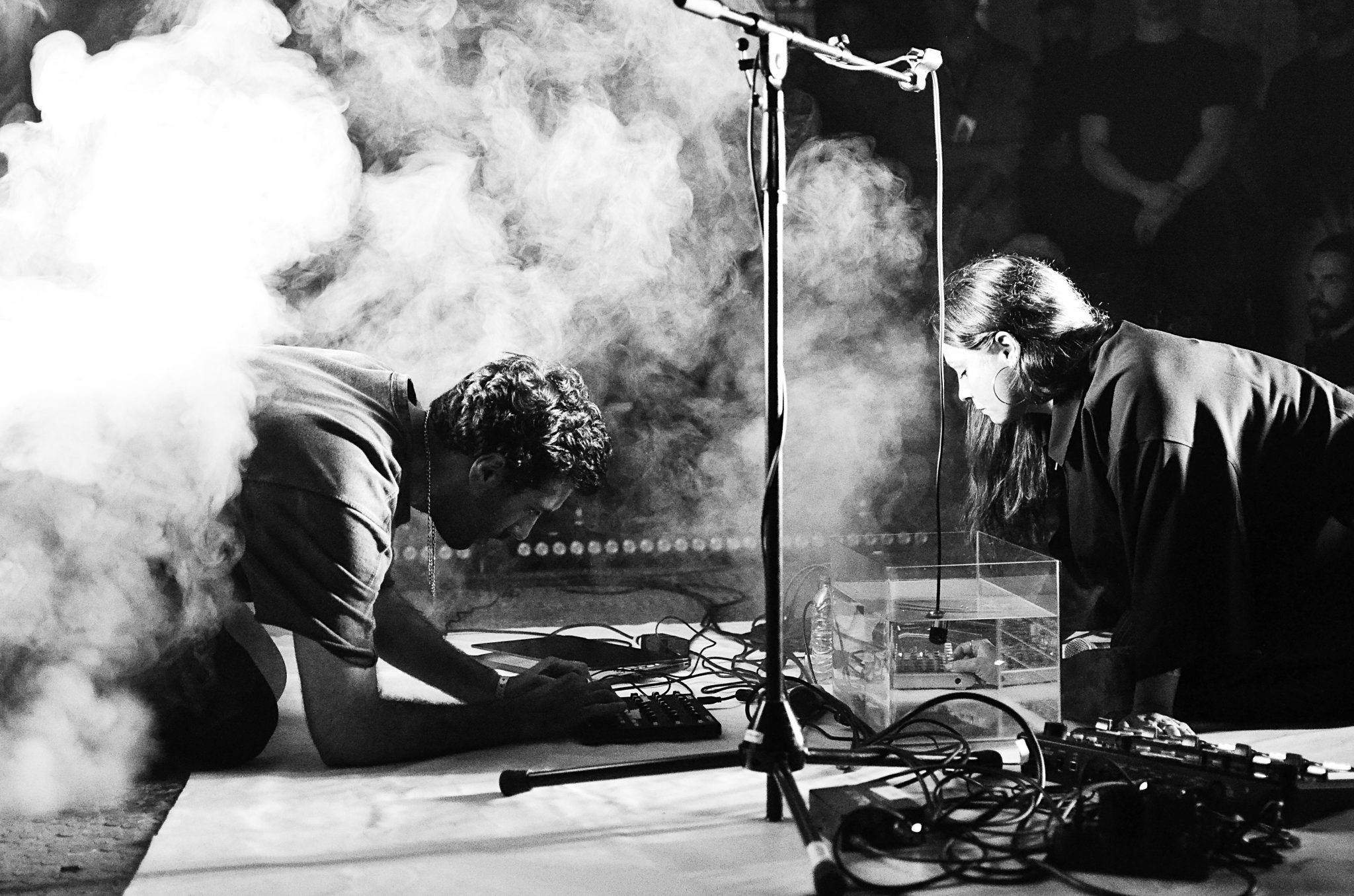
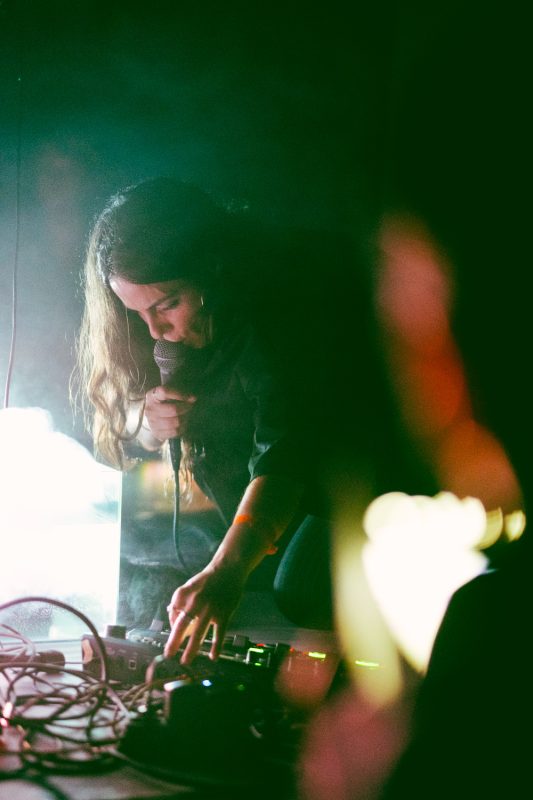
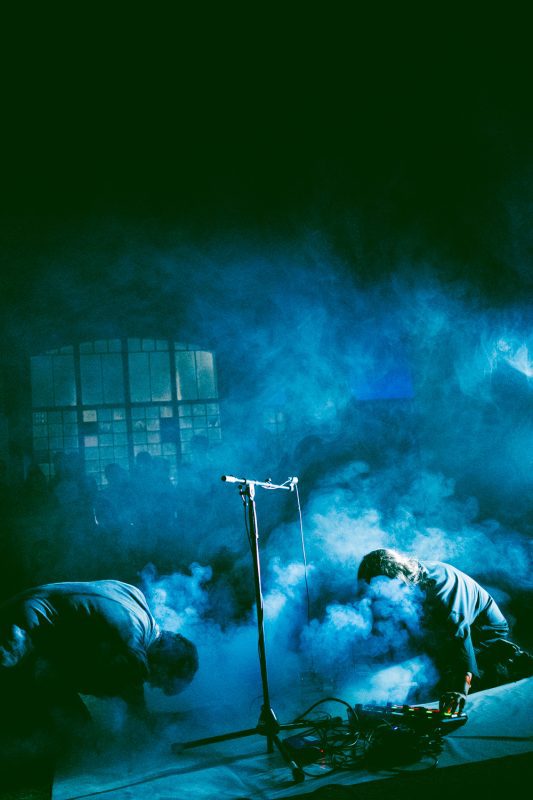
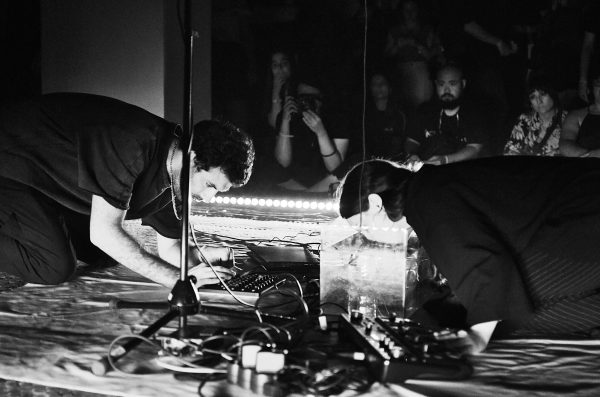
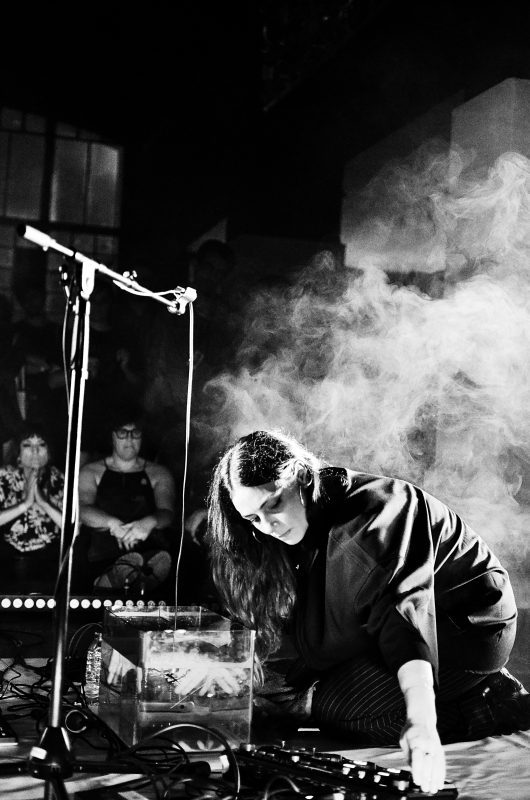
Carincur is a multidisciplinary artist who initiated the ceremonies of the closing night of OUT.FEST 2022, at ADAO. Together with João Pedro Fonseca, who manipulated the lighting, Carincur played with her mini-aquarium, an apparatus she utilizes to manipulate her voice, synthesizing it with electronics through the aquatic matter, submerging the room and the crowd into a profound state of trance through Sound.
We had the pleasure of talking to Carincur in anticipation of the festival, accepting her invite to visit the space of her label ZABRA, where we talked about her musical formation, the challenges of cultural promotion in Lisbon, the post-human, and touching on the genesis of the project she’s been working on with VR, now recently unveiled to the world: Body as a Frozen Metaphor.
Could you tell me about your musical path so far? How did you start making music, what was your first instrument?
It started when I went to the conservatory to study music, and my first instrument was piano and then voice. I still haven’t finished my course. (laughs) Then I began studying acting, and I started making music with a different approach because it wasn’t enough for me to be just a good musician in the classical sense - I wanted to make my own compositions; it was a very natural process. In my performances, sound was always a key component, and once I recorded my first album, that became much more apparent and affirmed.
In a previous interview, you mentioned a teacher who helped you think about music in another way - I myself was lucky enough to have had a teacher who didn’t change my perspective necessarily, but expanded it. I wanted to ask what that was like for you, what’s it like to have someone show you a different way of thinking and who changed your academic and artistic trajectory?
At that time it was extremely important for me, because I was in a phase where I was sort of feeling really frustrated, there was a lot of pressure because I wanted to graduate as fast as I could, I wanted to go into musical sciences, and I was feeling extremely tired, none of what I was doing made sense to me. And when I met that wonderful professor, who broached topics I was into, and unlike the rest of the conservatory, which is a really rigid and demanding academy, she had a sensibility that stood out from the rest of the teachers. She didn’t demand virtuosity, or perfect playing, or singing. She always said the most important thing was not the way we touched the keys or strings, how fast we played, but the form and energy that we put into our playing, same for the voice. And that made me question if that’s the kind of relationship I wanted to have with music, one that’s so technical, rigid and square. She introduced me to artists like John Cage, it was the first time I heard about that type of music within the conservatory and from there I started investigating further and my horizons expanded. It’s horrible to say, but she made me give up the course, but she also made me get to the place I’m at so I’m eternally grateful. We still talk to this day, we are close friends.
I realize some teachers really do want to open those doors. They are within that very formal structure, but they truly want to change that paradigm from within.
Yes, that’s also very important - to stimulate creativity and critical thinking, because for me - of course it’s important to know the history of things, the canon, I’m not one to burn no libraries or anything of the sort! (laughs) But for me as a creator, to just be repeating something that’s been repeated thousands of times, I just think… Art is also progress, and it’s also important to talk about the now and to write about what’s happening today. So, to remain in an idea of the past, I think that’s always reductive in some way.
And when you left the conservatory, was that when you decided to follow the path more related with theatre and performance?
Yes. After I left, I took a sabbatical. I was sort of lost because I thought “OK, how do I combine these two worlds?” So I started a musical theater course that I hated immediately! (laughs) “What am I doing here, this is not what I signed up for.” So not even a year later I quit, and I started studying theater at Caldas da Rainha. It wasn’t my first choice, but I was very happy to go there. It was also a school where I didn’t study just to be an actress, so I had contact with lighting, with sound, I also had incredible teachers who inspired my sound studies quite a lot, and it was during that course where I joined a collective called YUUTS RUOY, we did a lot of performances. During that time I did a lot of creative work, Caldas da Rainha has that energy of people doing things all over, studios constantly open, spaces always open for creative proposals. It was a time where I really, really explored and discovered my own language. And so when the course ended, I continued to create all the time.
With YUUTS RUOY, I read that you didn’t always know what you were doing but that the desire to create and to do things was enough. After some years, do you think you have a better perspective on what your goals were?
I think it was just that, and it was special because of that. I think we were always following our own intuition and I find that very beautiful. Afterwards, everyone followed their own paths, but because we were very young, it was a very enriching time because we were always down to do things and to research, investigate, discover and it was really… It was as simple as that, and I think it was really powerful to have been able to… it’s difficult - we were young, we were in a place outside our home, and we had the courage to create just because, without expecting anything in return. It’s a time I look back at fondly. It then transformed into something else, we stopped making things for a while and we started programming events. We also launched a magazine that unfortunately only had one edition because we were completely self-financed, so the second edition is yet to be made. I hope one day it can come out as an object of remembrance. But we started to make a giant compilation of emerging art made in Portugal, because we felt we had a kinship, we felt a bit invisible ourselves, so we wanted to make a collection that could also shake up events where artists like us could participate, who didn’t have as many opportunities, to give them a chance to showcase their work. And it was there that we stopped, because of lack of time and lack of funding.
Could you talk about ZABRA a little bit, as a record label, and how it expanded its definition? What are your ambitions now?
The label started to expand due to the elements present: me, João Pedro Fonseca, Noura, we are all multidisciplinary artists, and through my releases, I always seek that balance - that in one way or another, it’s not just about music. The releases we put out, we want them to be objects: more than a vinyl record, or even just a CD, we want them to be complete artistic elements as a whole. So, because we come from such different artistic practices, we brought our interests into the label itself, and we started to put that into practice. And it’s happened very organically, we are very happy with it.
The space itself belongs to Omnichord Records. They have had a lot to work on, and we lived in this neighborhood, so they started inviting us, asking if we wanted to make things here and make use of this space, and we spent a year or two doing performances, concerts, a big amalgamation of things! (laughs) It was very natural. A time came when we thought: it makes total sense to move our work space here. Unfortunately it’s not open every day because we don’t have that availability, but it’s very important for us to have a space where we can bring artists that fit into ZABRA’s vision, either visually or sonically as well.
Talking about programming, what would you say are the biggest challenges when it comes to programming?
I think right now the biggest challenges boil down to something I’m a little daunted to speak about, because I think we live in very delicate times. I think programming carries an enormous responsibility, and we have to be really respectful of who we are cohabiting with, who we are inviting, to be conscious of which communities we are contacting, so that we aren’t appropriating them. This has a lot to do with entities… a lot of times not so much regular programmers, but the bigger ones, the ones who fund us or whatever, who sometimes make demands that I would say are a bit disrespectful. I think it’s very easy to fall into programming where we use women, or people of color, or trans people as a token, and that’s very tricky. Above all, when I’m doing that type of work and I’m in contact with someone, I have to go in depth, and really communicate with that person, try to understand their reality, and to do it in the most appropriate way. I think that’s crucial, to create that dialogue and never allow it to be just something I buy and commission. No, it needs to be a conversation, I think that’s really important and one of the biggest challenges right now.
I totally agree, I think it’s essential to be inclusive, to include not just local people but also from different non-normative margins, all the while being careful not to fall into tokens, or those concepts of the “third world” or even “world music”. I think you have to be really careful with that and not just appreciate, but also to be able to respect people but also their ideas.
And it’s also important that we listen to them. I think even more important than programming is to also have those people constitute as part of the team, it’s to allow them to programme. For example, me, as a woman, I’m part of ZABRA but I’m also part of Zigur and I organize the festival ZigurFest, and unfortunately I’m still the only woman that’s part of the team, and I think that’s not enough, there has to be more involvement… I think from there we can start to deconstruct the paradigm of it all, and I think that’s the next step.
That really is apparent, the lack of women involved in the world of music, and that raises some questions: why are there so few women making or programming music, or being included in general in this world?
It’s a delicate topic because it’s complex, isn’t it? It’s a long history. And that’s why it’s necessary to value, insist, and understand. Just like you said, why aren’t there as many women making music? Why don’t they feel comfortable putting themselves out there? And I think that says it all, right? Because of this, it’s important to give space so that they can do it, to value them, and it’s important to have women say that to themselves as well, so that we don’t fall into the issues of tokens. But it’s a complex issue, I think it’s an ongoing and continuous process and it’s necessary to create a dialogue to understand what happened, what’s happening at the moment, how can we change this in a healthy and communicative way, never turning from one extreme to the other. It’s crucial for all these communities to be able to cohabit and not turn against each other, I’m not interested in that. I’m not here to judge… Sure, I want to dismantle patriarchy, but I’m not blindly supporting a matriarchy instead. I want to cohabit with those who are different from me, and above all… For me it would be perfect if we didn’t have to see each other as men or women, that we could respect each other as people, to work together as equals, with equal importance and respect.
It’s a cliché to say “we are all human” but it’s sad that it’s not common sense either.
It is a cliché but alas, it’s not practiced as such.
This past year, particularly in music, you have collaborated with other people in duo or trio formats. I imagine it’s something that’s natural for you because you come from theater, where you work with so many people behind the scenes, from lighting to set design. But, for example, you went to MUPA and you collaborated with the Carmo Choir alongside João Pedro Fonseca, and I wanted to ask what have you learned from these collaborations and if you have applied any of it into your practice.
Collaborating is always an intense and complex process, usually because people from such different backgrounds are trying to find common ground. I think it’s very different when you decide to collaborate with someone else, when you do in fact want to work with that person, like it’s the case with João. We have a giant artistic chemistry, we have worked together for a very long time. Even before I joined the label, there was already a common vocabulary… We talk very much in the same language, even if the results are different. It’s easier to collaborate that way I would say.
Now, when it’s a collaboration that you don’t choose… there’s programming curations that are very much focused on that. That’s an enormous challenge, because it can go really well, or those people can simply not be able to work together, but the end results I always find incredible. I think it’s an enormous exercise for the inner self, an ego death of sorts. And I think it’s super important, really. When I do “solo work”, or when I’m the creative director rather, I never feel like the final piece is just mine. Like you were saying earlier, this type of work always involves different people coming together to collaborate and for me they are intrinsic to the work, from the person who is designing the lighting, to the person that’s building what I need, we are collaborating and thinking these things through together. And for me, collaborating is always an enormous learning process, and there’s this notion that we can transcend and reach a higher level working alone, but in my perspective I think that’s impossible. And it also has to do with the previous question, it’s really important to communicate with each other, to create a dialogue and to research together, I think that’s what takes us to new places.
Now going back to your instruments, I don’t know if it’s in fact a constant presence in everything you have worked on, but I feel like the voice is always a component very much present in your work. I wanted to ask, what fascinates you the most about the voice? In a lot of ways, it’s the instrument that’s most natural to us all, right?
The voice has a quality that fascinates me a lot, which is, like you said, it’s the first instrument that we all use. We are born and we cry. And with the passing of time, I feel like we start to disconnect a lot from it. When I do workshops, it’s very normal for people to say they don’t know how to sing. It’s very interesting to me, because it’s a very academic view of what is considered to be an objective way of knowing how to sing, or how to make music, but I think everyone has that potential naturally - we all have a voice. And I think it’s really important to reconnect with this instrument that we carry with us every day, and to listen to it because the voice is really powerful. And because I find it so interesting to use and what comes out of it, what makes it the main starting off point of my investigation is to understand these transitions from this voice that’s connected to my body and flesh, to one that’s more post-human. Not just an organic one in the sense of flesh. And I always find it interesting to work with it as a technological extension, whether it’s processing it or synthesizing it, and I like to create devices that allow me to elevate it to new places. And along the way, also learning how this transition pans out - will I be able to have a conversation in this manner in a few years? Will I be able to put an effect on my voice? (laughs) Or change it in whatever way I want it to sound like, just like how I dress myself, will I be able to choose how I present my voice? These questions interest me a lot. Did I answer your question? (laughs) But yes, for me sound always starts from the voice. Maybe it’s a yearning to return to it, to reconnect with it, and to pass that interest to other people, that’s also key for me.
Can you talk to me about the workshops you do, how do you try to motivate people or incentivize that connection?
I’ve only done two voice workshops, and honestly people are always a little uneasy because it never starts with the voice. I always do exercises first to try to deconstruct everything and to have the body available and alert, trying to help those people to be able to set aside their self-doubt, I think that’s the first line of action. Usually they are physical exercises, somewhat intense exercises, and from there we start to play with the voice. I like to use the term play because it eases the process - when we use the word “singing”, it carries a lot of baggage. And it’s always beautiful to see the place where people get to when they suddenly realize the potential that the voice has, because “singing well” is only a tiny fraction of the potential of the voice, but to be able to fully use it simply for what it is… it’s everything, it’s a whole universe into itself. And that really interests me. We do various exercises that are a bit more practical, and then we start playing with the machines, of course.
And I wanted to ask as well about that mechanical component, and to play with it like you said. At least for me, I’ve started to notice a certain fascination for the voice in contemporary music - auto-tune isn’t necessarily a new thing, but I notice a certain tendency towards stuff like ASMR even, I don’t know if you have noticed that convergence lately in your circles or in the music you listen to.
I never thought about that. You talked about ASMR and that’s a good example, because ASMR can also work a little bit like therapy, and of course there’s a lot of people making music with that, but initially that wasn’t really the intention it started with. I’ve also played with ASMR, I find it incredible (laughs) But I think in some way, it’s very therapeutic and pure to work with the voice. It’s really cathartic for me, so… I don’t know, I think a lot of music is being made with that but I’m not sure it’s necessarily a conscious decision, I don’t know the motive behind it. Perhaps it has to do with living in, I don’t know, I’m probably rambling but, we live in such a depressed society, with so many problems of anxiety, maybe in some way it’s some sort of scream of despair, as a way to reconnect with ourselves and with others too. Maybe it’s that, or not that at all (laughs) I don’t know. But it’s a pertinent question, I’ll sleep on it.
I notice that you have a fascination for the post-human, that cyborg component of sorts, in which you can view through various lenses. Instead of asking if you have a positive or negative view of the future of humanity and what lies beyond it, I wanted to ask if you have hope for the post-human?
Honestly it doesn’t have to do with hope, because we already are post-human. It’s got everything to do with things I have been reading, from Donna Haraway, N. Katherine Hayles, and the texts these women wrote opened my eyes to this question and made me pause. Because everything we talk about that’s related to this topic of the cyborg or post-humanism, there’s a sort of alarmism about its dangers, like VR, AI… Of course it’s dangerous, but so are we as human beings, we are an extremely destructive species but also extremely kind at the same time. It’s complex. That’s why it’s so fascinating to me, and we ourselves don't fully understand how we work, especially our brain.
I also think we are very stubborn, and we’re being stubborn when we refuse to see ourselves as cyborgs in fact, because something like the cellphone is already an extension of ourselves - no one is able to live without their cellphone. The cellphone is an extension of our memory: I’ve got my calendar, my alarm clocks, everything is in there, even our digital identity. Of course it’s a complex issue and there are things that are in fact very dangerous about these technologies, but that’s why I think it’s important to start accepting this fact and to stay alert and aware of how we use these devices as extensions of ourselves. I really believe the future can be incredible. Because it’s so complex, of course it will bring less than positive things. But that’s the beauty of being human, or more than human… I can tell you now, I’ve been working on my new project, and it’s very much centered around all these questions and I will be working with VR, my new instrument. The last one I made was the aquarium and that symbiosis it has with the voice, and now I’m developing this instrument that’s a VR application, and from there I will try to find that symbiosis that will act as my new sonic instrument.
So, I think the potential is enormous in the digital context. So far I have worked a lot with these electronic questions, because the machines were physical, but now what really excites me is to go into a more digital spectrum, and in some way, understand that my non-flesh body can also perform, or find how it works in that context. I really think there’s so much potential… suddenly I am able to sing with Kanye West or whoever (laughs) I think it’s genius, really powerful. And also giving power to how we present ourselves to the world, or how we decide to do it. Suddenly, my voice turns into something else; suddenly what I am becomes something bigger than myself; suddenly all these networks that exist aren’t about me and you, we’re talking here right now but it becomes something so much bigger… Where will this interview end up, on the internet? So from this tiny space, it goes into a much larger universe, and I think that’s poetic (laughs) I find it beautiful.
Everything you’ve said have been things I’ve been thinking a lot about, before I was almost a moralist in a way, I was put off by the whole online thing.
I’ve also been that person.
I didn’t really want to be part of it, but suddenly I started to feel almost excluded in a way, and with a very negative worldview, missing the potential it carries, and I’ve been trying to be more open about it. Of course, you need to be careful and self-aware.
And sometimes you also need to abandon some crystallized ideas, because we can’t forget that humans have always had their own techno-fantasies. We always dreamt of flying, Leonardo da Vinci developed all that research, and because of that we were able to invent incredible technologies such as the airplane. So it’s all part of the process. And it also acts as an extension. So, primarily with VR, I feel like we are very scared about that, but it’s not about the evil it can bring, it’s the fear that we won’t be able to touch each other with the bodily flesh, which leads us to the question: what does it mean to be human? Are we just flesh? Is that all humanity is about? I think it’s so much more than that. So just like da Vinci dreamt of making wings you could fly, I think it’s really beautiful as well to think about how we can relate with each other in the face of this new technology since it will go beyond our bodily flesh. So I think… What I’m talking about seems like it’s much more of a spiritual question but it doesn’t have to do with that necessarily. Even if it’s not related to that physical touch of the flesh, I think we can deconstruct a lot of issues that currently disturb us, issues related to sexism or how we disregard the body, so it’s necessary to understand what place my body occupies and what it can achieve, what we can learn from it, and I think it’s important to always be questioning these things and to try to understand their potential.
You were talking about the spirit, which usually conjures ideas that are half-religious or kind of new age hippie…
(laughs)
It’s not like you can’t take anything meaningful out of those things, but at the same time you can view it instead as a spectrum, in the root meaning of that word, because you were talking about the voice, the voice is also a spectrum of sorts, sound is a spectrum, light is a spectrum, and like you were saying, what’s material and physical can also be deconstructed, and in my view that’s really important, to deconstruct ideas and thoughts.
There we go, deconstruct, not destroy. I don’t want to burn down libraries, I want to arrive at a new place with this. But now that you mention the voice, I think the voice challenges that notion, which is, everything starts within the bodily flesh. But very easily, the voice or music in general - art in general! (laughs) …it very easily touches you, in a way that’s not just physical, but we don’t see it really… I’m not touching you in this very reductive sense, I’m touching you in another way - they are waves, it’s a frequency. I’m here, my voice hits that wall and ricochets and gets captured by the recorder… So it’s a form of touch, but we can deconstruct that word or dig further into its meaning, or understand its layers and give it new meanings.
You wanted to make an installation at a certain point with the aquarium - did that end up happening?
No, (laughs) not yet because I didn’t play with it enough times to get to that place, or I didn’t receive the proposal to make it happen but it will happen at some point. I’d really like for it to happen, so that other people can also experience playing that instrument.
What would you say then is the biggest challenge playing with the aquarium? You must be pretty familiar with the aquarium by now but I imagine there’s still some unpredictable and volatile parts to it?
There’s so much unpredictability around it but that’s what I like the most about it, I like to play around with that a lot… Of course there’s a path I try to follow but I like to factor in that unpredictability, there’s always room for improvisation. I’m a different person each day, I’ll enter the water in a different way every time. Sometimes I’ll be more resistant, sometimes not so much (laughs) And that changes everything, the energy you bring into it is unavoidable - it must work as a whole or it becomes something else, and sometimes that’s the biggest challenge, it’s when I don’t spend enough time with it. Imagine, sometimes I have to play a show with it and I have two days to set it up. And then I have a period of five months where I don’t use it a single time. It’s what happened last time, I spent eight months without using it, so when I got back into it, I needed like a week to reconnect with it and the water itself, so that I could get to the place that interests me the most when I play it. I think that’s the biggest challenge, to try to always have some sort of…
A certain symbiosis?
Yes. I don’t like it when… it’s hard to explain, you can easily tell when I demonstrate it in person, but I don’t like it when there is an obvious separation between my body, the voice, the machine and the aquarium. I like it when they all become another whole being into itself. All of them together is what produces that result via sound, visuals, or whatever it may be. That’s what interests me. I don’t know how to explain it to you in words but if you saw it in person it would be really obvious I think. whatever. É isso que me interessa. Eu não sei como é que te consigo explicar isto por palavras mas se estivesses a ver ia ser muito óbvio, acho eu.
I think it’s a little bit like you described, the concept of water, of being such an important element, like you said it’s where we all come from. The baby is born in the water and in some ways doesn’t return to it.
Sometimes you’re afraid to return to it, sometimes you’re afraid to swim in it, sometimes you’re afraid of even jumping into it… So it is also connected to that return to the uterus and not being afraid of receiving that energy, or what it has to reveal to me, because water is truly powerful and carries a whole lot of memory inside it. It’s one of the elements that most fascinates me, and we as humans are composed mostly of water… I’m just trying to mix it all back together to its primordial essence once again so I can pull off my performance! (laughs)
Interview by Tiago Franco, conducted on September 14th, 2022, at ZABRA, Lisbon
A Bolsa de Criação Local OUT.RA 2026, atribuída à artista visual e sonora Alëna Koleso, culmina com a apresentação de “This is Possible Solutions 2”, trabalho desenvolvido em colaboração com Palm Laz (Henrique Lázaro).
Dois encontros com instrumentos familiares em territórios menos previsíveis.
Butthole Surfers, Sun Ra, Jason Molina, Hermeto Pascoal, Ghoya, Mogwai, Erik Satie, Amadou & Mariam, Witch Club Satan and Vítor Rua are among the figures featured in the programme.
Save the date! For the first time, Sonica Ekrano will take place at Teatro Municipal do Barreiro, home to the Arteviva theatre company.